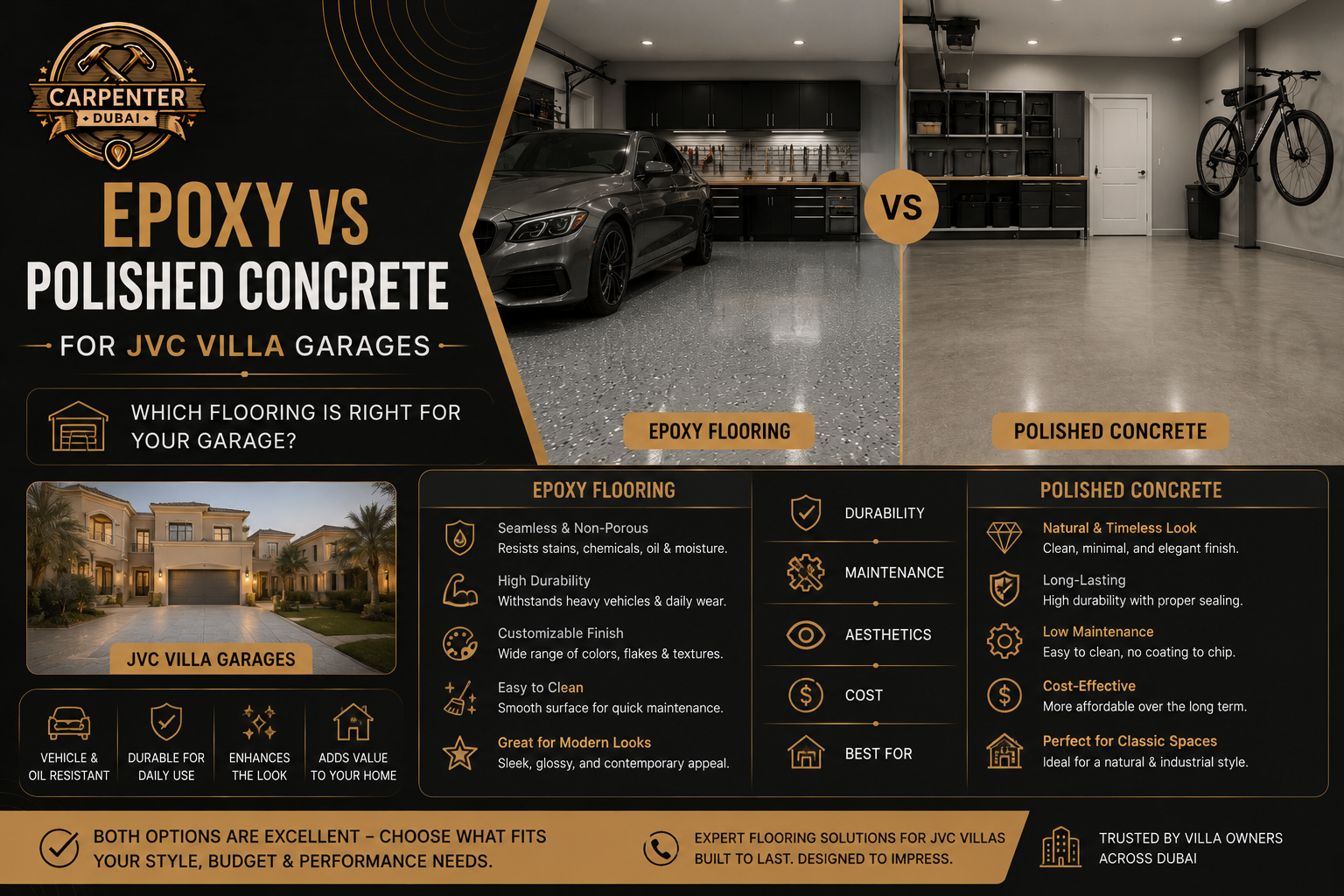
Why JVC’s Summer Heat Causes Garage Floor Cracking in Standard Epoxy
The intense summer temperatures experienced in areas like Jumeirah Village Circle can place significant stress on garage floor coatings. While epoxy itself does not typically cause concrete to crack, extreme heat can expose weaknesses in both the coating and the underlying slab.
Garage floors absorb solar radiation throughout the day, especially when garage doors remain open. Surface temperatures can become substantially higher than ambient air temperatures. As the concrete expands and contracts through repeated heating and cooling cycles, stress develops within the slab. If existing control joints are inadequate or the concrete contains shrinkage cracks, those defects may eventually telegraph through the epoxy coating.
Standard residential epoxy systems are often less flexible than industrial-grade formulations. When movement occurs beneath the coating, cracking, delamination, or localized peeling may result. Proper joint treatment, moisture testing, and crack repair before installation are essential to minimize long-term problems and improve coating durability in Dubai’s climate.
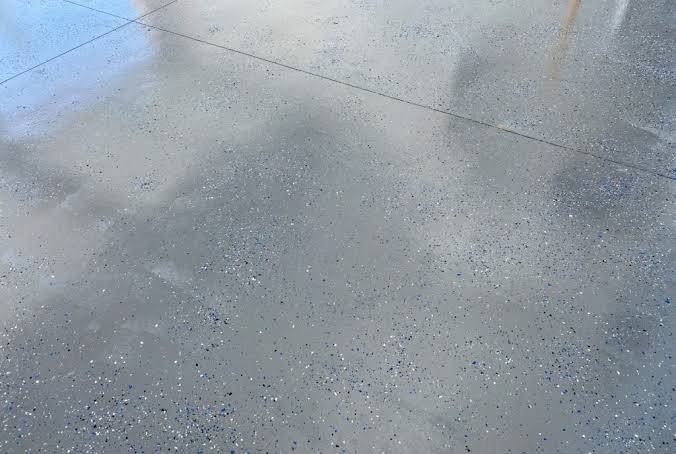
Load-Bearing Test: Polished Concrete vs Epoxy for 4×4 Parking in JVC
When evaluating garage flooring for large SUVs and 4×4 vehicles, it is important to understand that epoxy is a coating while polished concrete is a treatment applied to the structural slab.
The actual load-bearing capacity comes primarily from the concrete itself. However, the finish influences how well the surface withstands tire friction, point loading, and repeated vehicle movement.
Polished Concrete
- Excellent compressive strength
- Resistant to tire abrasion
- No coating layer to peel under heavy loads
- Performs well under repeated vehicle traffic
Epoxy Flooring
- Protects the concrete surface
- Improves chemical resistance
- Can experience wear in high-turning tire zones
- Requires proper thickness for heavy vehicle use
For most villa garages, both systems perform adequately, but polished concrete generally offers superior long-term resistance to mechanical wear.
Chemical Spill Resistance: Oil, Brake Fluid, and Battery Acid on Each Finish
Garage floors routinely encounter automotive fluids. The ability to resist staining and chemical attack is therefore a major performance consideration.
Epoxy Flooring
- Excellent resistance to oil spills
- Good protection against brake fluid
- Strong resistance to many automotive chemicals
- Easier cleanup due to non-porous surface
Polished Concrete
- More resistant than untreated concrete
- May absorb contaminants if not properly sealed
- Requires periodic sealer maintenance
- Acid exposure can damage the surface over time
For homeowners who frequently maintain vehicles, epoxy generally provides superior chemical protection.
Slip Resistance Comparison for Wet Garage Floors During Dubai Rain
Although rainfall is relatively infrequent, wet garage floors can become hazardous during storms or vehicle washdowns.
Polished concrete often provides good traction when properly finished, but highly polished surfaces may become slippery if contaminants are present.
Epoxy systems can be customized with:
- Anti-slip aggregates
- Quartz additives
- Textured broadcast finishes
These enhancements significantly improve traction while maintaining ease of cleaning. The safest solution is usually a textured epoxy system specifically designed for wet-use conditions.
Maintenance Frequency: How Often to Recoat Epoxy vs Repolish Concrete
Maintenance requirements differ substantially between the two systems.
Epoxy
- Routine cleaning required
- Localized repairs may be necessary in high-wear areas
- Recoating often needed every several years depending on usage
Polished Concrete
- Periodic cleaning and densifier maintenance
- Repolishing intervals are generally longer
- No coating layer to wear away
Over the life of the garage, polished concrete often requires less intensive maintenance than epoxy-coated floors.
UV Stability: Does Epoxy Yellow in JVC’s Direct Sunlight Through Open Garages?
Traditional epoxy coatings can discolor when exposed to ultraviolet radiation. In garages with open doors or significant sunlight penetration, yellowing may become visible over time.
Factors influencing discoloration include:
- UV exposure intensity
- Coating formulation
- Color selection
- Presence of protective topcoats
Modern UV-resistant systems perform significantly better, but standard epoxy remains vulnerable to color change. Polished concrete, by comparison, is largely unaffected by sunlight exposure.
Resale Value Impact: Which Flooring Do JVC Villa Buyers Prefer?
Buyer preferences often depend on the overall property positioning.
In many JVC villas, buyers appreciate:
- Clean appearance
- Low maintenance requirements
- Long-term durability
Polished concrete conveys a modern, premium, and industrial-inspired aesthetic. Epoxy flooring appeals to buyers seeking a highly finished garage with stain resistance and a showroom appearance.
Generally, professionally installed systems of either type contribute positively to buyer perception. Poorly maintained or deteriorating coatings, however, can have the opposite effect.
Combining Epoxy Base with Concrete Polishing for a Hybrid Durable Floor
Some homeowners explore hybrid systems that combine characteristics of both finishes. While traditional polishing and epoxy are usually separate approaches, hybrid solutions may involve:
- Densified concrete substrate preparation
- Decorative coatings over strengthened concrete
- Protective topcoats over polished surfaces
The goal is to combine:
- Concrete’s structural durability
- Epoxy’s chemical resistance
- Enhanced appearance and cleanability
Success depends heavily on proper product compatibility and professional installation.
Why Professional Surface Preparation Determines Epoxy Lifespan
Surface preparation is arguably the most important factor influencing epoxy performance. Many coating failures occur not because of product defects, but because the substrate was inadequately prepared.
Professional preparation typically includes:
- Moisture testing
- Mechanical grinding or shot blasting
- Crack and joint repair
- Contaminant removal
- Surface profile verification
Without proper preparation, even premium epoxy systems can suffer from peeling, bubbling, or premature wear. Conversely, a well-prepared concrete slab allows the coating to achieve maximum adhesion and durability.
For garages in Jumeirah Village Circle, where heat, dust, and vehicle traffic create demanding conditions, investing in professional surface preparation is often the single most important step in achieving a long-lasting floor.
Frequently Asked Questions
Does epoxy flooring hide existing cracks in JVC villa garages?
Yes but only hairline cracks; structural cracks must be repaired first or they’ll telegraph through.
Is epoxy garage floor slippery when wet from car AC drips?
Epoxy with anti-slip aggregate meets safety standards for safe walking.
Can polished concrete be colored to match villa interiors in JVC?
Yes, with integral dyes or stains, achieving terrazzo-like looks without joints.
Does polished concrete require expansion joints in large JVC garages?
Yes, every few meters to control cracking from thermal movement.
Which is more durable against heavy SUVs: epoxy or polished concrete?
Polished concrete is harder and more scratch-resistant; epoxy offers better chemical resistance.
Can I park immediately after epoxy installation?
No, wait several days for light traffic, longer for heavy vehicles.
Is polished concrete dust-proof in JVC’s dry climate?
Yes, when densified with lithium silicate, it becomes non-porous and dust-free.
How to repair a chip in epoxy garage floor?
Clean the area, apply epoxy patch compound, and blend with surrounding finish.
Does epoxy flooring emit odors during installation in a closed garage?
Yes, low-VOC epoxies minimize smell; ensure ventilation for 24-48 hours.