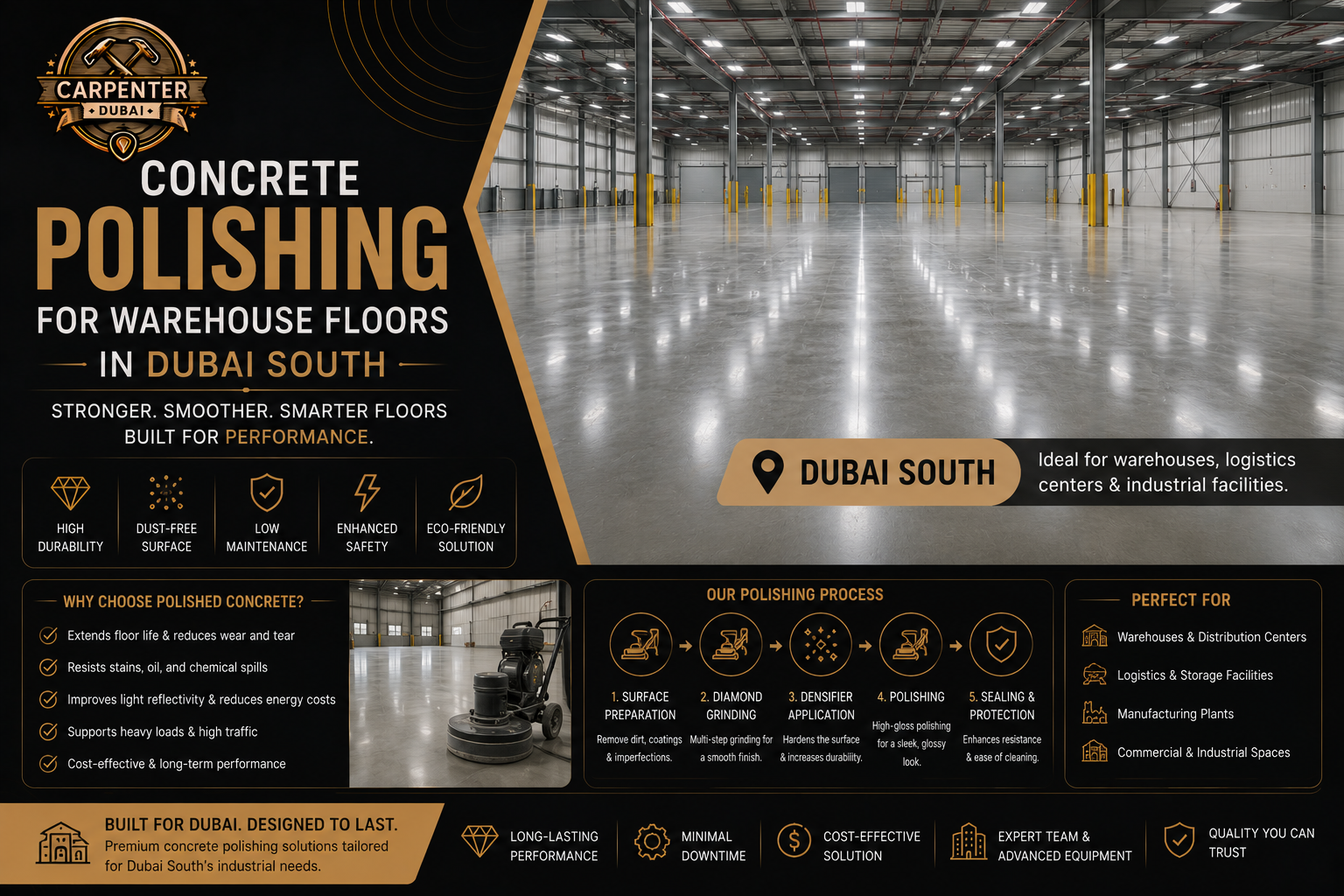
Why Dubai South Logistics Warehouses Need Dust-Proof Concrete Floors
Warehouses in Dubai South operate in an environment where dust control is critical to productivity, equipment reliability, and worker safety. Standard untreated concrete naturally sheds fine particles as surface abrasion occurs, a phenomenon commonly known as concrete dusting.
In logistics facilities, forklift traffic, pallet movement, and continuous loading operations accelerate this wear. Dust generated from the floor can contaminate stored products, clog machinery filters, interfere with automated systems, and increase cleaning costs. For facilities handling electronics, pharmaceuticals, or food-related products, dust control becomes even more important.
Dust-proof concrete floors are typically achieved through mechanical polishing and chemical densification. These processes strengthen the concrete surface, reduce porosity, and significantly minimize particle release. The result is a cleaner working environment, lower maintenance requirements, and improved operational efficiency.
As warehouse automation increases throughout Dubai South’s logistics sector, dust-resistant flooring is becoming less of a luxury and more of a standard operational requirement.
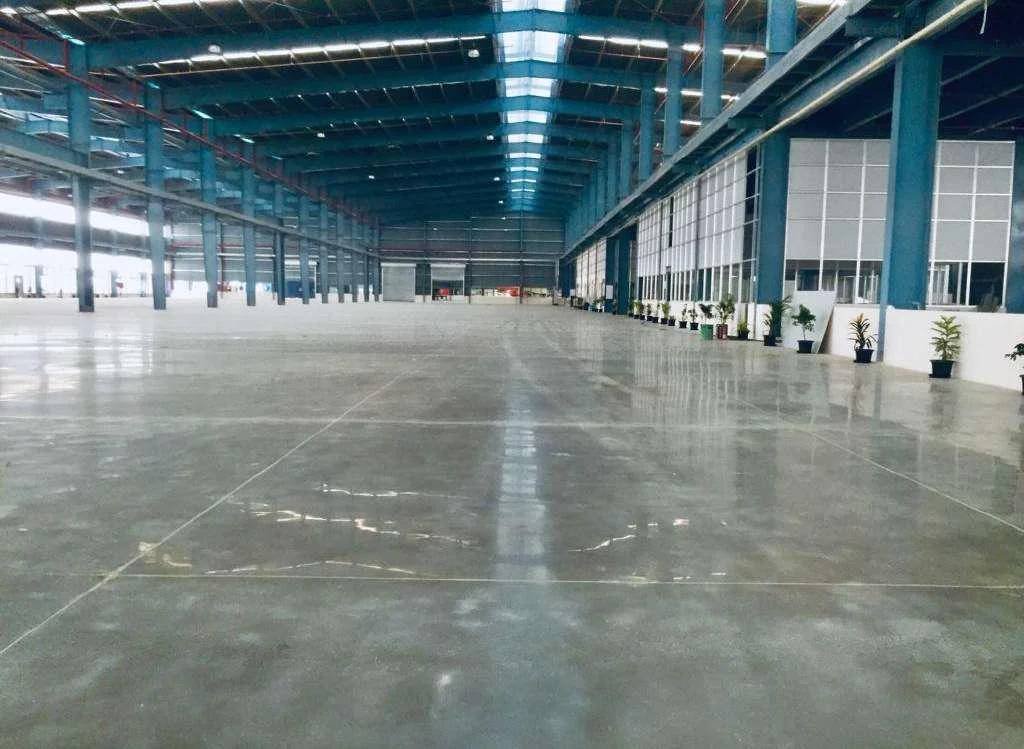
Load-Bearing Polished Concrete for Heavy Forklift Traffic
Polished concrete is particularly well suited for logistics facilities because it utilizes the structural strength of the existing concrete slab rather than relying on a separate coating system.
Heavy forklift traffic subjects warehouse floors to:
- Continuous wheel loads
- Repetitive impact stress
- Abrasion from tire movement
- Concentrated loading at rack locations
A properly designed and polished concrete floor provides excellent compressive strength and wear resistance. Because there is no coating layer to peel or delaminate, the surface remains durable under demanding operating conditions.
The key factor is not the polish itself but the quality of the underlying concrete slab. Proper mix design, curing practices, and surface preparation all contribute to long-term load-bearing performance.
Sealing Concrete Against Oil and Coolant Leaks from Heavy Machinery
Warehouse operations frequently involve equipment that uses hydraulic fluids, lubricants, coolants, and other industrial chemicals. Untreated concrete is porous and can absorb these substances, leading to staining and deterioration.
Protective sealers help by:
- Reducing liquid penetration
- Improving stain resistance
- Simplifying spill cleanup
- Extending floor life
Penetrating sealers are commonly preferred because they preserve the appearance of polished concrete while providing protection below the surface. Facilities with frequent machinery servicing may require additional chemical-resistant treatments depending on the severity of exposure.
Prompt spill response remains important because even sealed surfaces can suffer damage if chemicals remain in contact for extended periods.
Slip Resistance Requirements for Wet Warehouse Loading Bays
Loading bays are among the highest-risk areas within a warehouse because they are exposed to water, dust, oils, and heavy vehicle traffic.
Slip resistance becomes particularly important during:
- Equipment washdowns
- Rain events
- Product loading operations
- Condensation-related moisture accumulation
Achieving adequate traction requires balancing safety with operational efficiency. Excessively rough surfaces may improve grip but increase tire wear and cleaning difficulty. Properly finished polished concrete can provide both durability and safe traction when designed for industrial applications.
Regular cleaning is also essential because contaminants can significantly reduce floor friction regardless of the original surface finish.
Light Reflectivity Gains: Reducing Energy Bills with Polished Floors
One of the lesser-known advantages of polished concrete is its ability to improve interior lighting efficiency.
Highly polished surfaces reflect more available light, which can:
- Improve warehouse visibility
- Reduce dependence on artificial lighting
- Enhance workplace safety
- Lower energy consumption
Large logistics facilities often operate for extended hours, making lighting a significant operational expense. Increased floor reflectivity allows lighting systems to distribute illumination more effectively across the workspace.
The cumulative energy savings can be substantial in facilities with extensive floor areas and high ceilings.
How to Achieve Green Building Rating with Polished Concrete
Polished concrete contributes positively to many sustainability objectives because it often utilizes the existing structural slab as the finished floor.
Potential environmental benefits include:
- Reduced material consumption
- Lower maintenance chemical usage
- Extended service life
- Improved light reflectance
- Reduced replacement frequency
Because the floor itself is not covered with additional finish materials, resource consumption can be lower compared to many alternative flooring systems. This can support broader sustainability goals and green building initiatives.
The overall contribution depends on project-specific certification criteria and documentation requirements.
Joint Filling Techniques to Prevent Dust and Trip Hazards
Concrete joints are necessary to accommodate movement, but unfilled joints can create operational problems within logistics facilities.
Common issues include:
- Dust accumulation
- Forklift vibration
- Edge deterioration
- Trip hazards
- Wheel impact damage
Professional joint filling systems use durable materials designed to support traffic while allowing controlled slab movement. Proper installation protects joint edges and improves ride quality for material handling equipment.
Well-maintained joints contribute significantly to both safety and floor longevity.
Maintenance Schedule for High-Traffic Logistics Warehouses
Although polished concrete is known for low maintenance requirements, it is not maintenance-free.
A typical warehouse maintenance program includes:
- Daily dust removal
- Routine cleaning of traffic lanes
- Periodic inspection of joints
- Prompt spill cleanup
- Scheduled floor condition assessments
Traffic density, equipment type, and operational demands influence maintenance frequency. Facilities with continuous forklift operations generally require more frequent inspections than lower-traffic warehouses.
Consistent maintenance preserves both appearance and performance while extending the life of the flooring system.
Why Densifier Quality Determines Long-Term Dust Control
Densification is one of the most important steps in creating a durable polished concrete floor. Concrete densifiers react chemically with the slab to strengthen the surface and reduce dust generation.
High-quality densifiers provide:
- Greater surface hardness
- Improved abrasion resistance
- Reduced porosity
- Better long-term dust suppression
Inferior products may produce acceptable short-term results but often fail to deliver the same durability over years of warehouse operation. The effectiveness of the densifier directly influences how well the floor resists wear from forklifts, pallet jacks, and heavy industrial traffic.
Frequently Asked Questions
Does polished concrete crack under heavy forklifts in Dubai South?
It resists cracking when joints are properly spaced; slab may crack if subgrade fails.
Is polished concrete safe for food storage warehouses?
Yes, it’s non-porous after densification and meets food safety hygiene standards.
Can polished concrete be repaired if forklifts gouge it?
Yes, locally by re-grinding the damaged area and re-polishing; may show slight difference.
Does polished concrete need waxing?
No, lithium silicate densifier creates permanent hardness; waxing is optional for extra gloss.
What’s the reflective index of polished concrete floors?
High light reflection, significantly reducing lighting needs compared to painted floors.
Is polished concrete slippery when wet from AC condensation?
With medium grit polish, it achieves adequate slip resistance for warehouses.
Can old epoxy floors be converted to polished concrete?
Yes, but epoxy must be fully removed by shot-blasting before grinding concrete.
How to clean polished concrete floors in a warehouse?
Automatic scrubber with neutral cleaner and soft pads; avoid acidic cleaners.
Does polished concrete require expansion joints?
Yes, control joints must be respected and filled with flexible sealant.