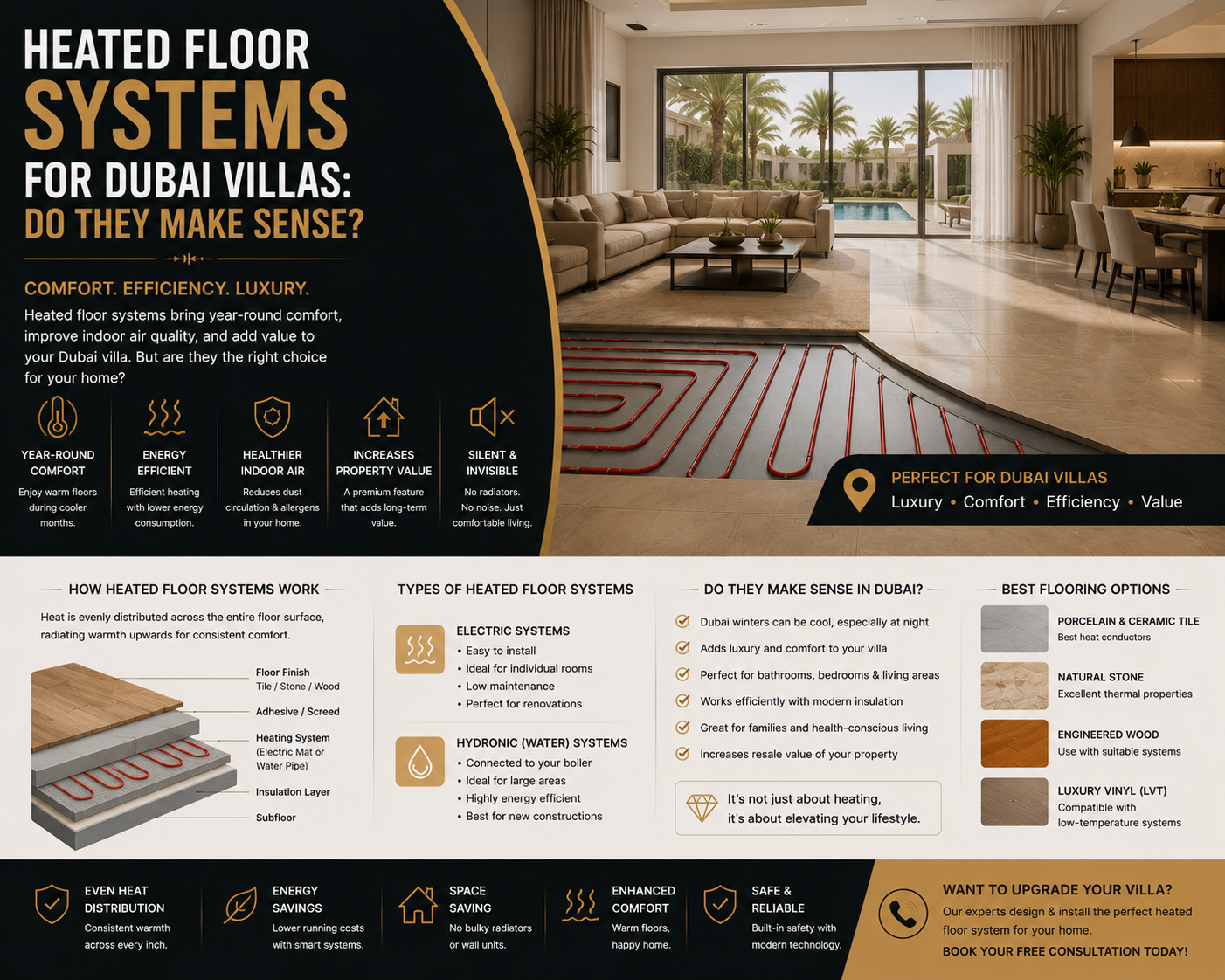
Why Dubai’s Cool Winter Mornings Justify Zone Heating
Even in a warm climate like Dubai, winter mornings can feel surprisingly cool indoors due to thermal mass in concrete structures and overnight heat loss through glazing. While central heating is rarely necessary, localized or “zone” heating becomes a practical comfort solution.
Bathrooms, bedrooms, and shaded living spaces often experience the most noticeable temperature drop in the early morning. Instead of heating an entire villa, zone heating allows energy to be directed only where and when it is needed. This improves comfort while avoiding unnecessary electricity consumption.
Underfloor heating is especially effective in this context because it provides gentle, even warmth at the occupant level, rather than relying on air temperature alone. This makes it a popular choice in premium residential interiors.
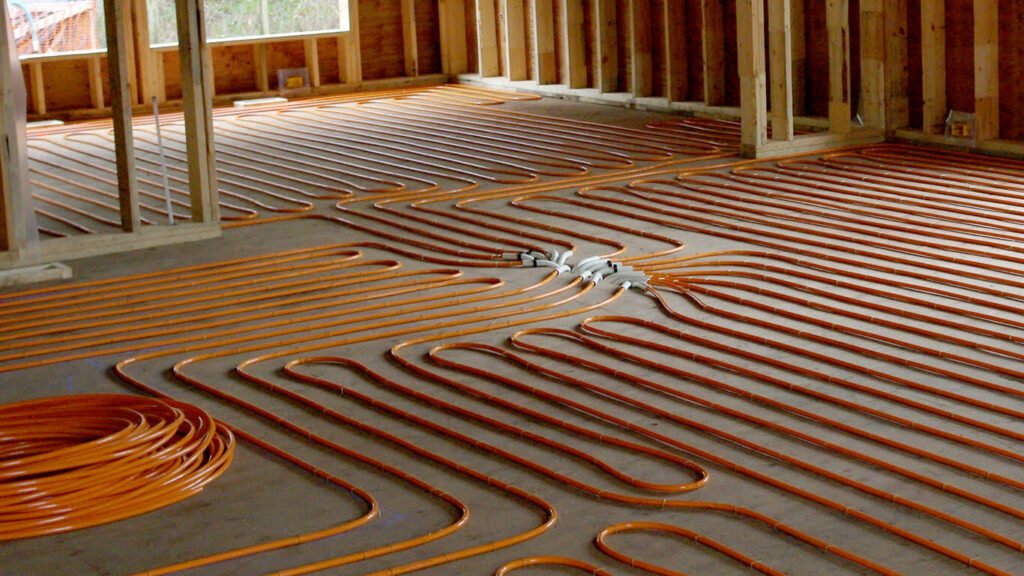
Electric vs Hydronic Underfloor Heating for Marble and Tile
Underfloor heating systems generally fall into two categories:
Electric Systems
- Thin heating cables or mats
- Easier retrofit installation
- Fast response time
- Higher running cost over time
Hydronic Systems
- Water-based pipes embedded in slab
- More efficient for large areas
- Higher upfront installation complexity
- Better suited for whole-villa systems
For marble and tile flooring, both systems are compatible because these materials conduct heat efficiently. In luxury residences in Dubai, electric systems are often chosen for bathrooms and small zones, while hydronic systems are preferred for full-home applications.
How Heated Floors Reduce AC Load in Shoulder Seasons
During transitional months, when temperatures fluctuate between warm afternoons and cool mornings, underfloor heating can actually reduce reliance on air conditioning.
By providing localized warmth in the morning, occupants may avoid overcooling indoor spaces overnight. This stabilizes comfort levels and reduces the need for rapid HVAC adjustments.
The key benefit is not replacing AC entirely, but smoothing temperature fluctuations so that HVAC systems operate more efficiently and less frequently.
Best Floor Coverings for Heat Transfer: Tile, Stone, Engineered Wood
Floor covering choice significantly affects heating efficiency:
- Tile and Stone: Excellent thermal conductivity; fastest heat transfer; most efficient
- Engineered Wood: Moderate conductivity; comfortable but slower response
- Vinyl and Laminates: Lower conductivity; require careful temperature control
Natural stone and porcelain remain the top performers for radiant heating systems due to their ability to store and release heat efficiently. Engineered wood offers a balance between comfort and performance, while synthetic materials require stricter temperature limitations.
Retrofitting Electric Mats Under Existing Flooring Without Demolition
In renovation projects, electric underfloor heating can sometimes be installed without full demolition, but only under specific conditions.
Possible methods include:
- Installing mats beneath new overlay flooring
- Using low-profile systems over existing tile (with leveling compounds)
- Integrating heating into renovation layers during re-flooring
However, height buildup and door clearance must always be considered. Full removal of existing flooring often provides the most reliable long-term result, especially in high-value properties in Dubai.
Smart Thermostats with Humidity Sensors for Dubai Climates
Smart thermostats are increasingly used to optimize underfloor heating in climates with high seasonal variation.
Humidity sensors add additional control by:
- Preventing condensation on cool surfaces
- Adjusting comfort levels dynamically
- Improving energy efficiency in mixed-use spaces
In Dubai’s environment, where air-conditioning and heating may alternate within short cycles, integrated control systems help maintain stable indoor comfort while reducing energy waste.
Running Cost Analysis: Master Bathroom vs Central Heating
Running costs vary significantly depending on system scale.
- Master Bathroom Heating:
Low area, short daily usage, minimal cost impact - Central Heating System:
Large area coverage, continuous operation, higher energy consumption
For most villas in Dubai, localized bathroom heating provides far better cost efficiency because it targets comfort zones rather than heating unused spaces.
Payback Period: Comfort vs Increased Electricity Bill
Underfloor heating is often justified not by direct financial return, but by comfort value.
Payback considerations include:
- Reduced reliance on space heaters
- Improved comfort during winter mornings
- Incremental electricity costs
In many cases, the “return” is measured in lifestyle improvement rather than strict energy savings. However, zoned systems can help control costs by avoiding whole-house heating.
Why Professional Load Calculation Prevents Overheating
Proper load calculation is critical in radiant heating design. Without it, systems may:
- Overheat floor surfaces
- Damage sensitive flooring materials
- Increase energy consumption unnecessarily
- Reduce system lifespan
Professional design ensures correct spacing, wattage, and control logic based on room size, insulation, and flooring type. This is especially important in luxury properties in Dubai where mixed materials (marble, wood, vinyl) require different thermal limits.
Frequently Asked Questions
Can underfloor heating be installed under parquet flooring in Palm villas?
No, solid wood and parquet crack; only engineered wood with thermal rating works.
Is underfloor heating safe with marble flooring?
Yes, marble is an excellent conductor; keep surface temperature moderate to prevent cracking.
How long does it take to warm a bathroom floor in Dubai winter?
Electric mats: minutes; hydronic: longer due to water mass.
Can I use underfloor heating in a JVC apartment?
Yes, but strata approval may be needed for hydronic; electric mats are usually fine.
Does underfloor heating increase home resale value in Dubai Hills?
Yes, it’s a premium feature, especially in master bathrooms and ground floor majlis.
How to retrofit underfloor heating under existing tiles?
Use electric heating film installed over tiles with new floating floor on top.
Is there a risk of overheating and floor damage?
Smart thermostats with floor sensors cut off at safe temperatures for all floor types.
Can underfloor heating be zoned for different rooms?
Yes, programmable thermostats allow independent control per room or zone.
Is underfloor heating more efficient than wall-mounted AC for heating?
Yes, radiant heat is more efficient and comfortable than forced air for winter warming.